Standards hierarchy
The standards hierarchy is used to model any object structure that is required for use cases such as
Risk Management, for example, an account plan to identify risk impacts on individual accounts, or
Sign-off Management, for example an account plan to perform sign-offs on balance sheet structures.
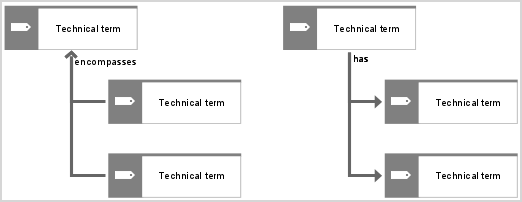
Use the Technical terms model model type and the Technical term object to model the regulation hierarchy. Use the Regulations and standards attribute of the Technical term object to uniquely specify standards. Use this attribute for Technical term objects or for the Technical terms model. When used for the model, all Technical term objects in the model are considered as standard. The hierarchy between the objects is represented by the has or the encompasses connection. In ARIS Risk and Compliance, only a tree structure for hierarchies is allowed. Therefore, each hierarchy element can only have one superior hierarchy element.
Object-specific control auditors and control test auditors can be modeled using this hierarchy type. These roles have read access to the control executions and control tests assigned to the hierarchy. The relation between the object-specific auditor role and the hierarchy is represented by the is owner of connection.
Attributes included into the data transfer
ARIS attribute | M* | Notes | |
|---|---|---|---|
Name | X | ||
Short description | |||
Description/Definition | |||
Sign-off-relevant | Used for Sign-off Management. | ||
Review-relevant | Used for Regulatory Change Management. | ||
*The M column specifies whether the attribute is a mandatory field.